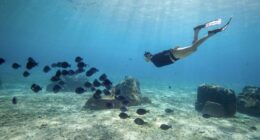
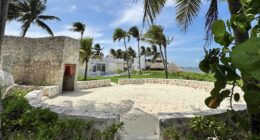
Photo Andaz Mayakoba
For luxury travelers considering the Mexican Caribbean, the calculus around security has shifted dramatically in recent years. While headlines occasionally stoke concern about broader regional issues, the reality on the ground for luxury travelers tells a different story: one of record-breaking visitor numbers, substantial government investment in tourist protection, and resort experiences that rank among the most secure vacation environments anywhere in the world.
Quintana Roo, the Mexican state encompassing the Riviera Maya, welcomed more than 12 million tourists between January and July 2025 alone, according to the Quintana Roo Tourism Secretary‘s report to the State Congress delivered in October 2025. Of those visitors, 66.1 percent were international travelers. Cancun International Airportprocessed 24.4 million passengers during the first ten months of 2025, cementing its position as Mexico’s busiest gateway for Caribbean tourism and a primary entry point for visitors from the United States, Canada, and Europe.
These figures represent a 3.2 percent increase over the same period in 2024, continuing a growth trajectory that has accelerated since the pandemic recovery began. The state now generates 46.4 percent of all foreign currency brought into Mexico by international visitors, making Quintana Roo the nation’s tourism economic engine. Hotel inventory has expanded to more than 135,000 rooms statewide, with 4,030 new rooms added in 2024 alone. When tens of millions of travelers vote with their wallets, the verdict on safety becomes difficult to dispute.
Government Investment in Tourist Protection
The Mexican government has responded to tourism’s economic importance with unprecedented security measures. Operation Summer Vacation 2025, launched in July 2025, deployed more than 7,000 security personnel across Quintana Roo’s tourist zones. This coordinated initiative involves the National Guard, Navy, Army, and state and local police forces operating across land, air, and sea patrols. The deployment represents the largest seasonal security operation ever mounted in the Mexican Caribbean.
At the municipal level, Playa del Carmen has implemented what local authorities call the “Iron Shield” strategy, stationing more than 1,000 active police officers specifically within tourist corridors. The municipality has also deployed 465 new patrol units, including rapid-response SUVs, ATVs for beach patrols, and motorcycles capable of navigating downtown streets. Cancun added 400 police officers in 2025 with an emphasis on professionalizing the force through enhanced training programs and body camera accountability measures.
The Tourist Police (Policía Turística) represent a specialized force trained specifically to interact with international visitors. Many officers speak English and are stationed throughout high-traffic areas to assist travelers and prevent petty crime. Their presence is designed around assistance as much as enforcement, creating a visible security layer that luxury travelers often describe as reassuring rather than intimidating.
Understanding the Advisory Landscape
The U.S. State Department maintains a Level 2 “Exercise Increased Caution” advisory for Quintana Roo, a designation that has remained consistent since January 2018. Context matters here: France, the United Kingdom, Germany, Italy, and Spain all carry the identical Level 2 rating from the State Department, often citing terrorism concerns.
The advisory acknowledges crime exists while noting there are no travel restrictions for U.S. government employees within Quintana Roo. The practical guidance emphasizes exercising increased situational awareness after dark in downtown areas of Cancun, Tulum, and Playa del Carmen, and remaining in well-lit pedestrian streets and tourist zones.
For luxury travelers, this guidance translates into behavior patterns that differ little from those practiced in any major international city. The Hotel Zone in Cancun, the pedestrian stretches of Playa del Carmen’s Fifth Avenue, and gated resort communities like Mayakoba operate under security protocols that often exceed those found at comparable properties in Europe or the United States.
The Gated Enclave Advantage
Mayakoba exemplifies the security architecture that defines ultra-luxury hospitality in the Riviera Maya. The 620-acre double-gated community, located 40 minutes south of Cancun International Airport and north of Playa del Carmen, encompasses four world-class properties: Rosewood Mayakoba, Banyan Tree Mayakoba, Fairmont Mayakoba, and Andaz Mayakoba. A fifth property, Alila Mayakoba, is slated to join the collection. Within this protected perimeter, guests move freely by bicycle, boat, or golf cart through freshwater lagoons, mangrove forests, and along pristine Caribbean beach.
The commitment to safety operates in tandem with the community’s welcoming atmosphere. Security personnel manage access at multiple checkpoints while maintaining discretion that allows guests to relax without constant reminders of the protective infrastructure surrounding them. The model proves that world-class security and world-class hospitality enhance rather than compromise each other.
Rosewood Mayakoba’s 130 suites each feature private pools, butler service, rooftop terraces, and boat docks. Guests arrive via luxury launches that navigate the property’s canal system. Banyan Tree Mayakoba holds Two Michelin Keys, AAA Five Diamond, and Four-Star Forbes designations. Its 123 villas incorporate Asian-Mayan design fusion, with staff removing their shoes upon entering private accommodations. Fairmont Mayakoba spreads across 401 suites with its own golf course, spa, and cooking school. The property recently completed a multi-million-dollar renovation emphasizing environmental consciousness alongside luxury. These properties operate within a shared ecosystem where guests can dine at any of the community’s 30-plus restaurants regardless of which hotel booked their stay.
The Butler Layer
Dedicated butler service at premier Riviera Maya properties extends beyond traditional hospitality into practical security territory. Grand Velas Riviera Maya, an 82-acre AAA Five Diamond property near Playa del Carmen, trains its butlers through 180 hours of classroom instruction and 60 hours of service training before they achieve ambassador status. The resort maintains a three-to-one staff-to-guest ratio for Grand Class accommodations, ensuring personalized attention that inherently monitors guest welfare.
At Viceroy Riviera Maya, an adults-only collection of 41 thatched-roof villas along seven miles of white sand beach, butlers handle everything from preparing fresh guacamole tableside to coordinating private excursions to nearby cenotes. The intimate scale (each villa includes a private plunge pool, hammock, and outdoor shower) means staff recognize guests individually within hours of arrival.
Royal Villa guests receive dedicated butler service alongside their own pool and indoor-outdoor living spaces. This level of personal attention creates a security blanket that operates through attentiveness rather than visible enforcement.
Controlled Transit Solutions
Transportation represents the primary vulnerability point for any traveler, and luxury properties in the Riviera Maya have developed comprehensive solutions. Resort-arranged transfers from Cancun International Airport in luxury vehicles with verified drivers have become standard practice.
Many properties include airport transportation in their room rates or coordinate services through vetted partners. The Guest Assist app, implemented by the Quintana Roo Tourism Security Board, provides real-time assistance to national and international tourists, helping more than 300 travelers during the first seven months of 2025 alone.
Within resort communities, controlled mobility eliminates exposure to external traffic. At Mayakoba, six miles of freshwater canals connect the four hotels via boat service. Bicycles wait outside villa doors for guests preferring pedal power. Golf carts provide on-demand transport to El Pueblito, the community’s dining and shopping village, or to the El Camaleón Golf Course, which hosted the first PGA Tour event in Latin America. Guests who wish to explore beyond the gates can arrange curated excursions through resort concierges who maintain relationships with vetted tour operators.
Practical Considerations for the Discerning Traveler
Luxury travel in the Riviera Maya requires the same common-sense precautions practiced in London, Paris, or New York. In-room safes should secure valuables and travel documents. Jewelry and designer accessories attract less attention when left in the suite during beach excursions. Alcohol consumption, particularly late at night, increases vulnerability regardless of destination.
The State Department recommends avoiding driving between cities after dark, a guideline that luxury travelers rarely encounter given resort transportation options. Application-based ride services like Uber, while technically operational in the region since January 2023, have generated security concerns; resort-arranged transportation remains the safer alternative. The “Verify and Travel” campaign launched by the Tourism Security Board educates visitors on recognizing legitimate service providers and avoiding fraudulent operators.
Playa del Carmen’s pedestrian-only Fifth Avenue offers a case study in urban safety design. The well-lit grid remains populated until 2:00 AM, creating natural surveillance through foot traffic. Unlike areas that spread along dark, narrow roads, Playa’s density works in its favor. Visitors can walk from hotel to restaurant to bar and back without leaving well-monitored corridors. The “eyes on the street” effect functions precisely as intended.
___________________
Bryan Dearsley is a luxury lifestyles writer, a prolific traveler, and the Founder of the Riley network of luxury lifestyle websites.